My blog can now be found on laurelshappytravels.home.blog
The blogspot app is no longer working properly.
I will add more blog posts starting this summer.
I hope to transfer my posts from blogspot over to the new blog site, once I figure out how to do it.
Happy travels!
Saturday, March 9, 2019

Thursday, August 30, 2018
Street art and graffiti in London - from a walking tour
My third street art and graffiti tour in London did not disappoint. Thanks to my guide Greg and the company "Free tours by foot" I had a great time walking around the east end of London looking at art.

Each year some of the street art is different from the year before. I saw quite a few new pieces up this summer.
The first piece of art I saw was by an artist named "Phlegm". (Most street artists have pseudonyms.)
He is from Wales, but now lives in Sheffield. His background is in cartoons and illustrations. This can be seen by the types of characters he paints and the black and white paints used. He spent 3 days on this mural. It was painted with a spray can. The owner of the building gave his permission to paint on that wall. It was completed 6 1/2 years ago. I am a bit surprised this piece has survived this long without getting painted over by another artist's work. You can see that some other graffiti artists have added to the painting (what they call a "tag" - the person's signature). One person painted "fussy" in way that does not interfere with the piece. This is called "fame bombing". It is a sign of respect to not cover up the artist's work with your art. Another person however did paint a tag on top of Phlegm's art. That is disrespectful to the original artist. It is interesting that Phlegm did not include his own tag to his piece. This street art is on Heneage Street in east London.
Museum of London - Exhibitions and Women’s Suffrage Movement
Towards the end of the exhibits in the Museum of London there were two sections that caught my interest - the exhibitions (kind of like our state fairs in the U.S) and the women’s suffrage movement.
There were 3 exhibitions mentioned that took place in the late 19th and early 20th centuries.
The Franco-British Exhibition of 1908 took place outside of central London in an area called “White City”. Its goal was to tout the success of Britain’s imperialism. Two colonial villages were set up to represent Ireland and Senegal. 150 Senegalese were brought in to the exhibit to take part in a “living village”. Daily activities in their life in Senegal were portrayed. It is interesting that some Olympic events took place in White City in 1908.
Another important exhibition occurred in Wembley Park from 1924-25 for 2 seasons. This was the British Empire Exhibition. 56 British territories were involved in exhibits. A stadium was built (called Wembley Stadium) for music performances, rugby matches, a rodeo and other events during the exhibition. Pavilions were constructed for each colony to display their goods. Palaces were built to showcase advances in British engineering (ie. trains), industry and the arts, and government. The goal of the exhibition was to stimulate trade and strengthen bonds between Britain and the colonies, plus learn more about each other. The exhibition over the 2 seasons was a financial flop. It did not continue after 1925. The only reminders of these events is Wembley Stadium (although the current stadium is not the original building) and some music written by Edward Elgar for the occasion (Empire March, Pageant of Empire and Crown of India).
Earl’s Court in London was another exhibition site from 1887-1914. It was a 24 acre site that included the 2 story Empress Theater and a 300 foot high Ferris wheel. In 1895 was an exhibition at this location called the “ Empire of India Exhibition “ and featured exhibits, food and shows about India. The impresario Imre Kiralfy wrote a show with dance, mime and songs about India’s history from 1024-1895. It was performed at the Empress Theater to great success. Over the years from 1887-1914 many exhibitions took place on this site and covered many topics, not only India. In 2014 demolition of buildings on this site started.
Below is a photo from the museum featuring the White City and Wembley Park exhibitions.

Many of these exhibitions were commercially motivated (for profit) and highly biased and misleading in their representations of the colonies.

There were 3 exhibitions mentioned that took place in the late 19th and early 20th centuries.
The Franco-British Exhibition of 1908 took place outside of central London in an area called “White City”. Its goal was to tout the success of Britain’s imperialism. Two colonial villages were set up to represent Ireland and Senegal. 150 Senegalese were brought in to the exhibit to take part in a “living village”. Daily activities in their life in Senegal were portrayed. It is interesting that some Olympic events took place in White City in 1908.
Another important exhibition occurred in Wembley Park from 1924-25 for 2 seasons. This was the British Empire Exhibition. 56 British territories were involved in exhibits. A stadium was built (called Wembley Stadium) for music performances, rugby matches, a rodeo and other events during the exhibition. Pavilions were constructed for each colony to display their goods. Palaces were built to showcase advances in British engineering (ie. trains), industry and the arts, and government. The goal of the exhibition was to stimulate trade and strengthen bonds between Britain and the colonies, plus learn more about each other. The exhibition over the 2 seasons was a financial flop. It did not continue after 1925. The only reminders of these events is Wembley Stadium (although the current stadium is not the original building) and some music written by Edward Elgar for the occasion (Empire March, Pageant of Empire and Crown of India).
Earl’s Court in London was another exhibition site from 1887-1914. It was a 24 acre site that included the 2 story Empress Theater and a 300 foot high Ferris wheel. In 1895 was an exhibition at this location called the “ Empire of India Exhibition “ and featured exhibits, food and shows about India. The impresario Imre Kiralfy wrote a show with dance, mime and songs about India’s history from 1024-1895. It was performed at the Empress Theater to great success. Over the years from 1887-1914 many exhibitions took place on this site and covered many topics, not only India. In 2014 demolition of buildings on this site started.
Below is a photo from the museum featuring the White City and Wembley Park exhibitions.
This year marks the 100th anniversary of the "Representation of the People Act of 1918". All men over 21 could vote in the constituency where they were resident. Women over 30 could vote, but only if they were "registered property occupiers" (or married to one) of land with a value greater than £5. This act was a great improvement over previous voting conditions for women. The Museum of London is honoring this anniversary with an enhanced exhibit on women's suffrage in England. In 1903 the Women's Social and Political Union (WSPU) was founded by Emmeline Pankhurst and her 2 daughters. It was a militant women's suffragette group that organized protest marches and committed acts of violence against property (arson, smashing windows, vandalizing homes and churches). They were trying to draw attention to their cause of a woman's right to vote. By being in the news and the newspapers they felt they would continue ro remind others of women's rights and voting inequality. It was an attention-seeking method. Many of the women who belonged to this group were arrested and sent to prison. There they went on hunger strikes and were tortured with forced feedings (physically restrained while force fed liquid through a nasal or stomach tube). Eventually the "Cat and Mouse Act" was made law in 1913. This stated that women who were weak in prison due to malnourishment could go home to recover. However if they resurfaced as healthy beings outside of their homes, they were subject to arrest again and sent back to prison. In 1928 the voting laws changed again and allowed all men and women over the age of 21 to vote.
Below is a description of one of the militant suffragettes. She endured a lot.
One brave woman!
I highly recommend the Museum of London and their exhibits. I always learn a lot there.
Tuesday, August 28, 2018
Victoria and Albert Museum, London - the Baroque and Rococco eras
On a rainy morning in London I made my way to the Victoria and Albert Museum for mainly a practical reason. I did not want to get very wet. I knew that once I was on the tube for the South Kensington stop that I would not have to resurface outside to get to the museum. There is a tunnel from the South Kensington tube stop to the museum. I easily walked there without getting wet.
Of course the museum is reason enough itself to go there, regardless of the weather.
I decided to check out the rooms called “Europe 1600-1815 Baroque”. This area covered the Baroque and Rococco eras. Each room had a theme. The first room focused on looking back to classic Greek and Roman art. The sculptor and architect Gianlorenzo Bernini created a fountain for the garden of Cardinal Montalto and called it “ Neptune and Triton” (1622-23). Here is the impressive piece.




Of course the museum is reason enough itself to go there, regardless of the weather.
I decided to check out the rooms called “Europe 1600-1815 Baroque”. This area covered the Baroque and Rococco eras. Each room had a theme. The first room focused on looking back to classic Greek and Roman art. The sculptor and architect Gianlorenzo Bernini created a fountain for the garden of Cardinal Montalto and called it “ Neptune and Triton” (1622-23). Here is the impressive piece.

Baroque designs focused on floral ornaments (flowers and fruit), mythological figures, emotion shown in faces and twisted columns. You see this everywhere.
Another room showed art that was a fusion of Mexican and European styles. This was due in part to the colonization by Spain of Mexico, South America and the Philippines. Much of this art had a religious theme.
Catholicism in art in the colonies and Europe was featured in one room. Here is an example of the crucifixion made in France (1664) of ivory.

Another room was called “Dutch Domesticity” and showcased dishes, wooden cupboards and household gadgets. In the following photo you will see a “curfew” to cover up embers to keep your fire warm overnight and a “warming pan” to pass through your bed sheets to heat them up at night before you go to bed. The description said “for women who haven’t got a man who can warm their feet for them “!

Global trade with Asia and the Americas was the next topic. Below is a coffer on a stand that was made in Japan for the European market and taste. It was made sometime between 1590 and 1625. It is made of wood with plates of shell and black/gold lacquer - all the rage in Europe at that time.

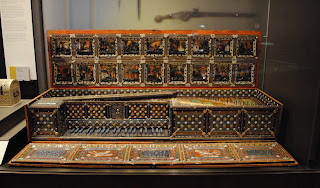
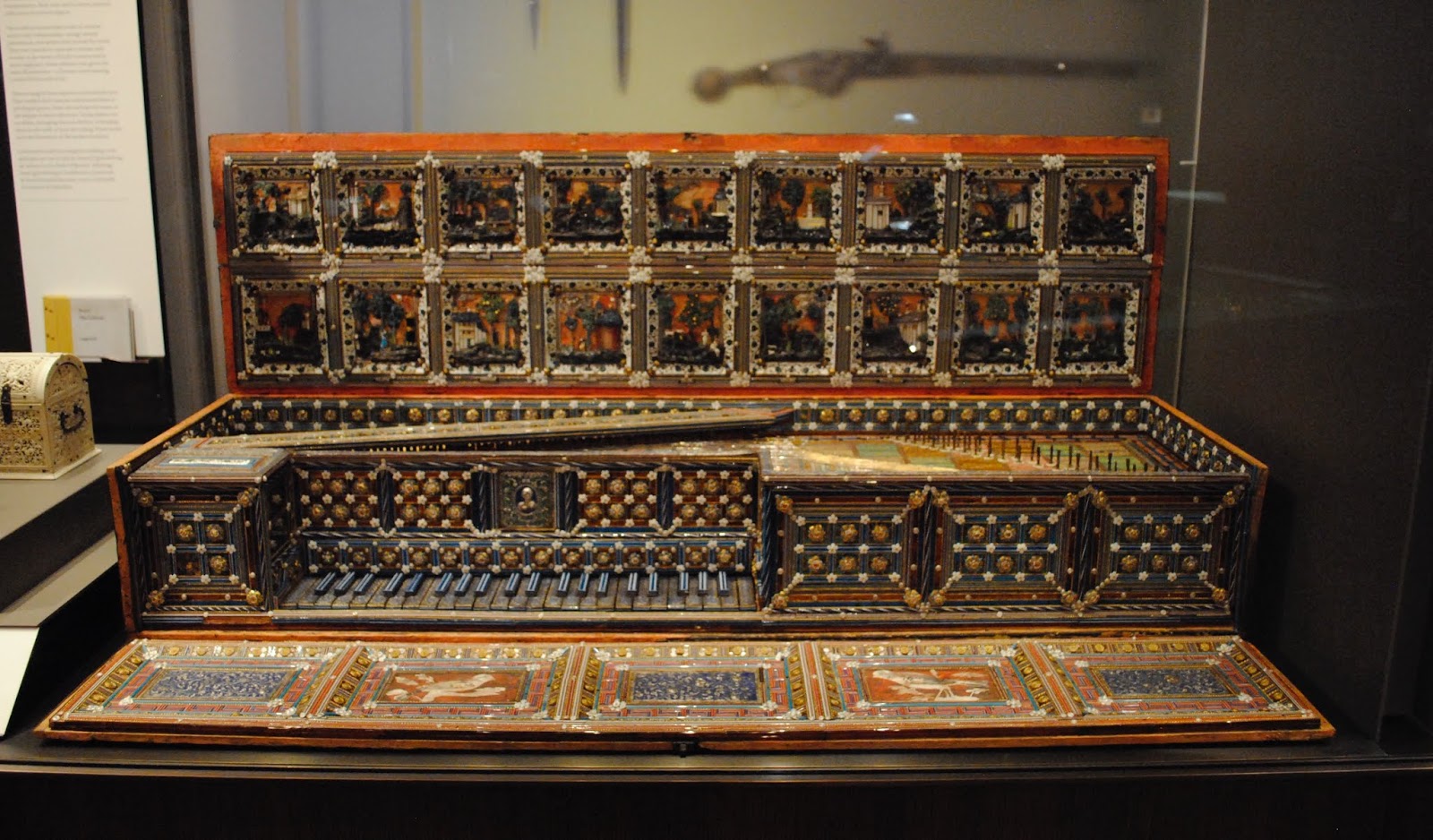
“The Cabinet” refers to either a private collector’s treasures or a storage cabinet. Both are found in this room. An example of the former is obvious with this glass virginal made between 1604 and 1620 in Austria or Germany. It is made of soft wood with decorations of silk and glass. It is able to be played.
An example of a decorative storage cabinet is seen in this Belgian cabinet depicting the story of the prodigal son. It was built between 1640 and 1660 of oak with ebony and oil painted panels. There are drawers to store your treasures.

The rise of France under King Louis XIV encouraged the promotion of the arts, as Louis was a big fan. He encouraged others to value the arts. The cabinet maker André-Charles Boulle, a friend of Louis, developed a technique of inlaying turtleshell, metals, bone, horn and ivory in wooden surfaces. The process is called “marquetry”. It is quite exquisite.
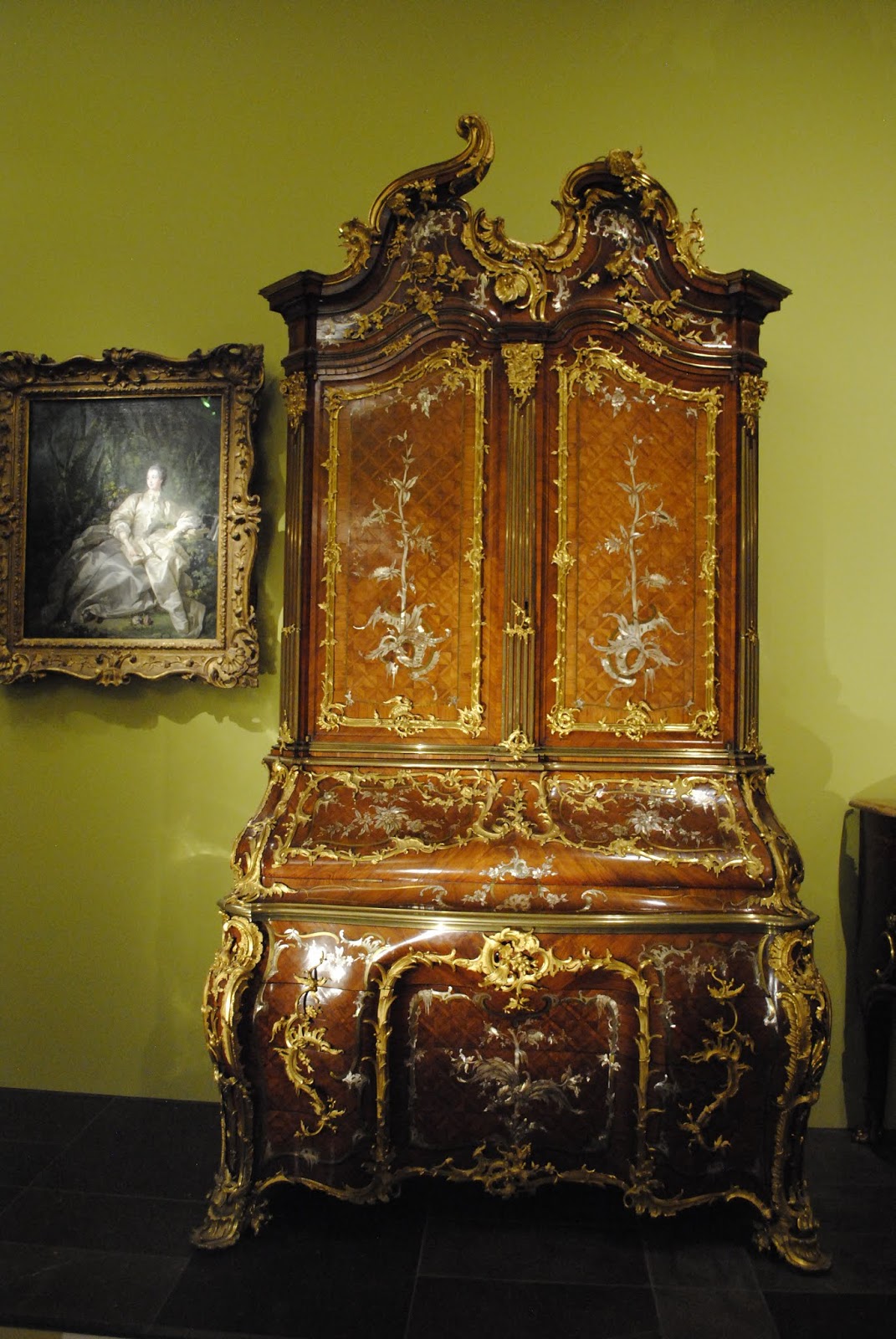
The Rococco period of art features curvy shapes such as scrolls in the shape of the letters “C” and “S”. The fad started in France and moved to Germany and Italy. Here is a writing cabinet made in Dresden between 1750 and 1755 for Augustus III, King of Poland.
This tile wall panel features musicians and dancers and was made in Portugal. It was meant for warm climates, as wall tapestries didn’t survive the heat and humidity well. It was made between 1720 and 1730.

After the Rococco room, neoclassicism was featured. A return to the Classical Greek and Roman styles with straight lines and restrained elegance was a welcome change in style.
I highly recommend a visit to this section of the museum. Next time I will try to find the rooms about Europe prior to 1600.
Monday, August 27, 2018
British Library

On this trip to London I wanted to make sure I visited the British library. I had heard about it through friends who have visited and done research there. The only photography allowed is outside the
building, so I’m stuck with the one photo above.
The library is located near the King’s Cross/St. Pancras rail and tube stations. In order to keep a similar look of brick buildings as the rail station, this building was also built with bricks. It took 37 years of planning and construction to get a completed library building in 1997. The architect was Sir Colin St. John Wilson. There are 4 levels of basements that are used for storage and go 24 meters underground. There is another library/storage facility in Boston Spa (in West Yorkshire). It is possible to visit this location and do research there.
I took a tour of the library. It is well worth doing so. The cost was £10. An employee of the library showed us around and we were able to go to some areas where the general public is not allowed. One of these places was the scanning and transporting room. This is where the requested library items are scanned into the computer and placed on a conveyor belt to go to their final destination to be picked up by the library patron (usually to an assigned reading room based on the item’s subject area such as the humanities, social sciences, maps etc). The guide also spoke about the history of the library, the various rooms in the library and how you can get a reader pass to do research.
The main library in London (the one I visited) has exhibit rooms for rotating special exhibits (admission is charged) and rotating free exhibits. By rotating I mean that the exhibits change during
the year. I opted for the big free exhibit called “Treasures of the British Library”. It showcases some of the library’s special manuscripts. The original music manuscripts were especially of interest to me. It was fascinating to see the originals of music by Purcell, JS Bach, Mozart, Handel, Haydn, Beethoven, Mahler, Britten, Elgar, Schoenberg and Vaughan Williams. Each composer had his own style of writing out his music (neat or sloppy and some with handwritten comments in the margins and portions of the music crossed out). It was really interesting to recognize on paper pieces I have performed. In addition to music, there are manuscripts from literature, historical letters and religious books.
In addition to the exhibit rooms there are 11 reading rooms devoted to various areas such as maps,
Asian and African Studies, science, humanities, manuscripts, rare books and music, and a newsroom.
In order to look at materials in the library (and possibly check out certain items), you need to apply for a reader pass. It is a closed shelf system at this library. There are strict rules about what you can and cannot take into the reading rooms. You are allowed to photocopy or take pictures of the item you are researching, however there is a limit to how much of the item you can copy. They don’t want you copying the whole book.
There is a six story glass tower in the middle of the library that is home to the private collection of King George III (the mad king). This area is locked and accessible only to staff that are assigned to work in that tower. Many first editions of books are located there.
A Business Centre is also a key part of the library. There is a big collection of information on business and intellectual property to help you start, run and grow your business, protect your ideas and research your markets. It is possible to network there and make business contacts, as well as meet with advisors who can help direct your research and business projects. I imagine these services are used often by entrepreneurs.
There is a wing of the library devoted to the conservation of materials. When an item needs to be repaired, it comes here. This area is not open to the public, unless there is an advertised, library-sponsored event there.
In addition to visual materials, the library has a large collection of audio materials (recordings of music, speeches, interviews etc). You can get a taste of what they offer on the library’s website. Look for “sounds of the library”. You can listen to some recordings online without being a member of the library. I got stuck in the section of a reading of a children’s book by English speakers from various countries. I must admit I was disappointed by the section of regional American readers because the accents from various parts of the U.S. were not that distinct. For example the reading representative from the Boston area did not sound that different from the reader from Oklahoma. It was interesting for me to hear the various accents around the U.K., especially the Liverpool area.
I highly recommend a visit to the British Library. I spent hours there. If I ever want to do research, I would go there to do it. Apparently Johnny Depp does (for his movie roles).
Sunday, August 5, 2018
View of Port Isaac from the breakwater
If you manage to arrive at Port Isaac's harbor at low tide, you can walk up to the bottom of the breakwater and climb up the ladder to the top. The view of Port Isaac from the breakwater is fantastic. You can even look over to the other breakwater on the opposite side of the harbor.


I highly recommend keeping an eye on the tide. We barely made it back to the harbor in Port Isaac before high tide came in. We got our feet a bit wet on our return due to the rising water.
Walking up to the breakwater from the harbor of Port Isaac.
You walk on that strip of pavement on the left from Port Isaac harbor to the bottom of the breakwater. At high tide that pavement is under water.
From one breakwater looking over to the other breakwater.
From on top of the breakwater looking towards Port Isaac's harbor.
Monday, July 2, 2018
Back in action soon!
Hello,
 Royal Albert Hall, London, at the BBC Proms.
I will spring back into action soon with more blog posts coming on London and Cornwall. Be on the lookout starting in late July.
Sunday, August 27, 2017
Street Art Tour, east end of London - summer 2017
I took part in a walking tour on street art and graffiti in London's east end. This was the second time I took this tour. The last time was in 2015. The company I chose both times was Free Tours by Foot. They offer tours on many topics in London (and other cities worldwide). Professional guides lead you interesting places. For their work you pay as much or little as you like at the end of the tour. Our leader this time was Colin. He was highly energetic and entertaining as he led us around the east end looking at art on the street. He was very knowledgeable about the subject.
On the tour we learned about the many forms of art on the street and the various methods involved in making the art. There are works that are painted using spray cans, paint rollers and stencils. Other forms of art involve small and large sculptures made of bronze, plaster or polyurethane, for example. Vinyl stickers are sometimes slapped on surfaces (even street signs). "Paste-ups" are often posters made at home and pasted on surfaces. Sometimes real objects are used, such as the famous cars of the artists D*Face and Banksy near the old Truman brewery.
In this post I will show you the highlights of our tour. Most of the art I saw this year was different from the art I saw in 2015. That is not surprising. Street art is very temporary. I was actually pleasantly surprised to see a few pieces that are still around from 2015. This post focuses on the new art I found this year.
This is a photo of a mural on Hanbury Street, off of Brick Lane, in the east end of London. The artist is Sam Worthington, aka "Wasp Elder". He is from Cardiff and is now based in Berlin. He comes back to the UK to make street art and occasionally has solo shows in art galleries. This piece is called "Manufacturing Consent" and is obviously influenced by Noah Chomsky's book of the same name. Both Chomsky's book and Wasp Elder's mural are a commentary on mass media. Wasp Elder took 3 images from the news media about recent protests in the Ukraine and created this pastiche of characters for this mural. Wasp Elder's solo gallery exhibit from April 2017 in London ( called "Victims of Circumstances") contains the individual paintings of these three characters. From what I have seen on the Internet, Wasp Elder gravitates towards political themes in his works. His work is thought provoking. His website is www.waspelder.com

Another politically-based street art commentary is seen in this next "paste-up" on Spital Street. A "paste-up" is street art that is created at home and pasted on an outside surface. The inspiration for this piece came from Barack Obama's presidential campaign poster from 2008, designed by artist Shepard Fairey. The campaign poster was a drawing of Obama's head and the word "hope". In 2010 during the U.K.'s general election the British newspaper the "Sun" came out with the image of conservative leader David Cameron's head and the word "hope", borrowed obviously from the Obama campaign. The artist in the street art below is spoofing the Cameron poster by superimposing Cameron's head on Obama's head and writing "no hope". This is in reaction to Cameron's departure as prime minister after the pro-Brexit vote won in 2016. He was clearly for remaining in the European Union.
"Un Kolor Distinto" is the name of the Chilean duo street artists Sammy ("Jekse") Espinoza and Cynthia ("Cines") Aguilera. They are based in Valparaiso, Chile and have been commissioned by the local government to create public works of art in that city. Their works have spread to other cities in Chile as well as international locations. Their tools are spray cans. The style is very "distinct" with bright colors (hence the duo's name "Un Kolor Distinto"). The figures represented in this art have been called by some as reminiscent of those in surrealistic art. More information about the artists can be found by doing an Internet search (though much is in Spanish with little or no English translations).
Jose Sabate (aka "el Pez") from Barcelona has a very distinctive artist signature on his street art - a smiling fish. The fish signature has overtaken many of his pieces of art. The fish figure evolved from a drawing of the letters "Pez" (fish in Spanish) to a combination of those letters and a fish-shaped figure. Eventually the fish figure survived on its own without the word "Pez". The artist wanted to spread happiness so he made the smiling fish. In addition to fish, the artist has incorporated monsters, demons and other creatures into his work. He is known internationally. This work below was created in 2015 for a project to beautify east London. It is located off of Brick Lane, in a cul-de-sac area called "Seven Stars Yard". Note the crossed out word "peace", replaced by "Pez". Also the words "Montana Colors" in the upper left hand corner refer to the artist's preferred brand of spray paint from a Barcelona-based company.
East London based street artist Jim Rockwell, aka "Jim Vision", has produced some wonderful art mostly based on the world of fantasy. In 2015 when my husband and I did a street art walking tour of the east end of London we were shown a huge tribute mural to the British fantasy writer Terry Pratchett. Unfortunately the work has been painted over, as happens to most street art. My guide this year showed me a smaller work by the same artist. The subject is an owl. I have seen many pieces with owls done by this artist. He must like that bird!
Jim Vision heads an artist collective called "End of the Line". Among some of their activities they paint huge murals for businesses who want outdoor advertising. Jim also heads up an annual art festival in the east end of London called "The Meeting of Styles", where artists of all sorts come together and create art.
The east London street artist "Stik" has created a unique stick figure of 6 lines and 2 dots to convey messages of unity during troubling times in communities around London and the world. He is based in Shoreditch, an area in the east end of London. He started making street art in 2002. For a period of about 10 years he was homeless and living on the streets or in homeless shelters in east London. His works range from smaller pieces to murals - some authorized to be painted, others not. He leaves us with social commentary about the state of local communities. It is amazing how he can express so much with a simple stick figure. He is the social conscience of the community. With his art he has spoken out in support of public health services, the preservation of communities in the face of urban development and other topics. This piece of Stik art is located on Princelet street in the east end of London. I am not clear what the topic is. I can guess it may be unity in diversity. I think someone added the elephant in the piece, as I have seen photos of this work without the elephant. For more information on the artist do a search on the Internet.
On Hanbury Street in the east end of London are several murals, including the first one I wrote about by Wasp Elder. Here is another by "Senzart 911", South African artist Senzo Nhlapo. There is little information about him on the internet. He has a Facebook page (Senzart 911) and blog on Wordpress.
His art is very colorful and African-influenced.
Another artist with work on Hanbury Street is the Brazilian Alex Senna. He is known for drawing black and white silhouette figures. He often portrays the neglected in society and shows their humanity in scenes of love and solitude. His work appears worldwide on streets and in art galleries. Here is a solitary figure and his shadow on Hanbury Street. There is more information on the artist and his art online.
The London artist "Stedhead" (aka Meagan Hindley) has a background in illustration. She is inspired by body contour and motion. In this street art in the Seven Stars Yard area off of Brick Lane she shows her love of those things plus music. Her art is seen all over - on walls, in shows and festivals, and even on bodies as tattoos. More information about her is on Facebook under "Stedhead Art".
The British born Ghanaian artist Neequaye Dreph Dsane (aka "Dreph") is based in London. He has just completed a series of 10 large scale outdoor portraits of notable local African/Caribbean women who are making significant contributions to improve the lives of the young and underrepresented. The portraits are in various locations around London. This particular portrait below is of Myvanwy Evans from Shoreditch. She helps mentor young disadvantaged people in the area. This portrait is also in the cul-de-sac Seven Stars Yard, off of Brick Lane. The series of paintings is called "You are enough". All of the ladies featured have shown remarkable courage in helping others.
"Mr. Cenz" is a London-based artist. He paints in several styles -from graffiti style letters to human forms. His latest projects have been women's heads. He paints in an abstract and flowing manner.
This piece below is on a garage door in Seven Star Yards cul-de-sac off of Brick Lane, east end of London. His other portrayals of women are in a similar style.
If you look up on the top of buildings in London, Los Angeles, Queens NY, Cracow or even Berlin, you might find a colorful mushroom perched on the roof. That is the work of South African Christiaan Nagel. He is based in London and travels worldwide to spread his mushrooms. They are made of polyurethane ("surfboard foam"), fiberglass and stainless steel. Christiaan spent a lot of time surfing as a kid, so he was familiar with polyurethane.The mushrooms come in bright colors- blue, yellow and pink. He came upon the form of a mushroom while he was experimenting with those materials. He noticed the materials made a fine mushroom cap. Christiaan started putting up mushrooms on his own (in the middle of the night). He now receives commissions for many of his mushrooms. This mushroom I photographed is on Brick Lane in the east end of London.
Christiaan also paints pictures and his works have appeared in exhibitions.
D*Face, aka Dean Stockton, is a London-born artist. He has a background in illustration. He grew up riding skateboards and was interested in the stickers pasted on skateboards. He was introduced to subway graffiti in NYC by looking at pictures in publications. His art is influenced by pop culture. He is a fierce critic of the evils in the modern world, such as consumerism. The Stolen Space Gallery in London often features his solo shows. His art has been featured all over the world in shows. Below is one of his street art pieces, located off of Brick Lane near the old Truman Brewery. The round head with wings is apparently his artist's signature. It appears on many of his works.


Clet Abraham is a French artist, trained in sculpture and oil painting, who lives in Florence Italy. He is known all over Europe and Japan for his stickers that he applies to street signs. These stickers provide an amusing modification of the sign without defacing the sign. He wants to draw more attention to the traffic signs. They are often overlooked and ignored by drivers.
This sign is on Brick Lane.
Clet has received mixed reactions from local authorities over his stickers. Some go along with it and even collaborate with him on further projects. Others find it inappropriate. His main opposition came in Japan, where his girlfriend was arrested, interrogated and imprisoned for helping post Clet's stickers in Japan.She was picked up by local Japanese authorities after he had left town. She was eventually released. He has been fined in the past for "defacing" street signs."Jonesy" is a Welsh artist based in London. He is a multi-faceted artist with activities in sculpture, painting, jewelry and musical instrument making. He is an environmental activist. That is often reflected in his art. In London some of his contributions to street art comes in the form of small bronze sculptures placed high on top of street signs or on walls. Here is an example of a decorated sign post in the east end of London.
Gregos, a French artist, has been plastering his image on walls worldwide for quite a while. He makes a 3D cast of his face with various expressions and puts them up all around. Some are big. Others are small. Some have a tongue sticking out. Others don't. Happy, sad. You name it. He is a self-taught artist. He experimented in different mediums before coming to sculpting. He encourages you to send him selfies with his sculpted masks. See his Facebook page for that activity. Below is an example of a Gregos mask from the east end of London. It does tend to startle you the first time you see one!
This concludes my blog post on street art from the tour in August 2017. I plan on taking this tour many times as there is always something new to see and a new artist to discover. I highly recommend this tour and this tour company, Free Tours by Foot.
Sunday, August 13, 2017
Victoria and Albert Museum - Britain 1760-1900


Here are some vases decorated with Ancient Greek themes.

This elaborate Persian style candle vase (1771) came from a noble's house in London.

There are display cases of dining rooms from 1760-1830. The French influenced the style with silver dinner service and porcelain dishes.


The textile printing industry thrived from the 1760-1840. Furniture and clothing reflected this. Here are material for chair backs and cloth for clothes.


Fancy objects in your home was all the rage. Here is an out of focus music stand from 1810. At least you can see the crescent shape, based on the shape of a Greek leather shield.
Alas styles and tastes change and move in a different direction. The Roccoco style came in vogue the early 19th century. Chinese and Indian influences crept into architecture and interior design during this time as well. A prime example is the willow pattern on plates (that blue and white depiction of a Chinese legend that you still see on grandma's plates). The Brits developed the design. A Gothic revival started in the late 18th century. It was regarded as a "morally superior style" as it was "British and Christian" and not "foreign and pagan". This Gothic style was seen in the rebuilt Palace of Westminster (parliament building) after it burned down in 1834. New designs were made for the chairs and wallpaper of parliament (from 1847-51).
In 1851 was the Great Exhibition of goods from England and her empire. It was a world fair. Queen Victoria especially liked the new Majolica glazes (of tin) on ceramics. Here is an example on a wine cooler. The queen called it " the Victoria wine cooler". She ordered some for her palace. 
Trade increased between Britain and her colonies in the mid 19th century. Importing and exporting happened more frequently with the aid of rail and steamships. As Japan opened its ports in 1850 to American and European powers, new design ideas crept into Britain. Nature themes and simplicity of form were elements taken from Japanese design. In 1870 a movement called "aestheticism" came and combined Japanese and Greek/Roman elements.
These rooms are only a few of many interesting ones on design in art. I leave you with a more contemporary piece that was hanging near a stairwell. I did not make it downstairs to see who it was by. The subject matter (of smashed brass instruments) is curious.
No comment....
British Museum - Mesopotamia area, 6000-539 BC

Be prepared to wait in line to get in the museum, to get an audio guide and to get food. This is a popular place.
I took the tour called "Ancient Iraq" (although "Iraq" did not exist at that point). Rather it was the area called Mesopotamia, between the Tigres and Euphrates rivers, where this tour began. Some of the cities mentioned were Ur (in current southern Iraq), Nineveh and Babylon.
The photo below of a lion is from the throne room of King Nebudchanezzar II, who reigned from 605-562 BC in Babylon. He said the lion represented himself. What an ego! He had a palace, walled city, a gate called " Ishtar" and a royal processional walkway. The city of Babylon was thriving then. The top of the wall was wide enough to allow 2 chariots to pass each other and was the fastest way to get around the city.
In the part of the museum about the city of Ur you find information about the development of writing, a popular board game and the Royal cemetery. Writing was first done with pictures drawn on clay tablets. Later symbols developed that represented sounds or abstract ideas (called "cuneiform"). I did not take pictures of the clay tablets as they were small and very detailed. Popular drawings represented items such as beer and barley (for bread making). These clay tablets were often receipts of goods bought or received.
The popular board game "The Royal game of Ur" was around for about 3,000 years. It spread from this area to India and China. It involves 2 players moving game pieces around the board as efficiently as possible to finish first. In this photo you can see the game board, playing pieces (buttons) and 4 sided die. I think stick die too. The rule book for the game was written on the clay tablet.

Rumor had it that 2 bored guardsmen at a gate etched a game board on the base of a monument so they could play in their spare time!
A royal cemetery was found and archeologists were surprised to find luxury items in it, such as this silver lyre.


This was rebuilt, as some of the wood on it had deteriorated. Much of it was made of silver, including the original pegs lying at the foot of the lyre. This instrument is from 2500 BC.
Here is a text describing what archeologists found at the dig site of the Royal cemetery.
I guess the royals believed you had to take everything and everyone with them into the grave.
On to the area of Assyria and the city of Nineveh where King Ashurbanipal ( 668-630 BC) collected a library of texts from all over the area. It is the world's first library. The king asked everyone to make copies of texts from all over the empire and bring them to his library. Any subject was accepted. The texts were mostly copied on clay tablets. When a fire swept through the library in 612 BC, many of the clay tablets survived. The tablets in the photo below discuss rituals/protocol for a substitute king and queen if they had to suddenly come to power and the rituals/procedure for rebuilding a temple.
The library could have looked like this.
Some of the texts have been translated and can be found at http://oracc.org/asbp
These were only highlights of the Mesopotamia area of the museum. The tour really helped make sense of what I was seeing. The audio guide helped also. I would recommend both.
Pace yourself in this museum. Much to see here.
Subscribe to:
Posts (Atom)